Dosbox Serial Port Settings
Posted By admin On 19.12.20- Dosbox Com Port Configuration
- Dosbox Serial Port Settings Windows 10
- Dosbox Serial Port Setup
- Dosbox Serial Port Settings Pc
- Dosbox Serial Port Settings Asus
You can specify other machine settings such as graphics, memory, and sound. It is somewhat equivalent to a virtual machine. The vast majority of software ever written for DOS (including Windows 1.x, 2.x, and 3.x) will run on DOSBox. Mounting Drives And Commands To Run On Startup. You can use this to capture any data sent and received through any Windows COM port. If DosBOX is sending something to serial ports then it has to go through the Windows serial driver and the data. USB/serial converters with dosbox. Which matched the settings on the com port from the old Mac and the settings in the timeclock software. Windows Serial Port Programming 2) Using the Serial Ports in Visual C 3) Serial Communication in Windows; 1) You can use this with Windows (incl. MinGW) as well as Linux. Alternative you can only use the code as an example. 2) Step-by-step tutorial how to use serial ports on windows. 3) You can use this literally on MinGW.
Dosbox Com Port Configuration
It's always good to know that things work before mucking around with them. I also ended up using the real serial port on my main desktop. Either way, any serial port will work. Install your COM port and make sure your DOSbox configuration is correct as per the hardware port number. Mine is COM1 on this main desktop. Write the current configuration settings to a file in a specified location. 'filelocation' is located on the local drive, not a mounted drive in DOSBox. The configuration file controls various settings of DOSBox: the amount of emulated memory, the emulated sound cards and many more things. It allows access to AUTOEXEC.BAT as well. To capture different parallel ports and serial ports simultaneously, each Printfil copy running on the PC will have to redirect its own LPT port or COM port to a different temporary file (for example e:TEMP LPT1.txt and e:TEMP LPT9.txt) to avoid mixing or overwriting different print jobs.
#include <string.h>#include <ctype.h>#include 'dosbox.h'#include 'inout.h'#include 'pic.h'#include 'setup.h'#include 'bios.h'#include 'callback.h'#include 'serialport.h'#include 'directserial.h'#include 'serialdummy.h'#include 'softmodem.h'#include 'nullmodem.h'#include 'cpu.h'Classes | |
| class | SERIALPORTS |
Macros | |
| #define | LOG_SER(x) log_ser |
| #define | BIT_CHANGE_H(oldv, newv, bitmask) (!(oldv&bitmask) && (newv&bitmask)) |
| #define | BIT_CHANGE_L(oldv, newv, bitmask) ((oldv&bitmask) && !(newv&bitmask)) |
Functions | |
| static Bitu | SERIAL_Read (Bituport, Bitu iolen) |
| static void | SERIAL_Write (Bituport, Bitu val, Bitu) |
| static void | Serial_EventHandler (Bitu val) |
| void | SERIAL_Destroy (Section *sec) |
| void | SERIAL_Init (Section *sec) |
Variables | |
| CSerial * | serialports [4] ={0,0,0,0} |
| static SERIALPORTS * | testSerialPortsBaseclass |
Macro Definition Documentation
◆ BIT_CHANGE_H
| #define BIT_CHANGE_H | ( | oldv, |
| newv, | ||
| bitmask | ||
| ) | (!(oldv&bitmask) && (newv&bitmask)) |
◆ BIT_CHANGE_L
| #define BIT_CHANGE_L | ( | oldv, |
| newv, | ||
| bitmask | ||
| ) | ((oldv&bitmask) && !(newv&bitmask)) |

◆ LOG_SER
Definition at line 40 of file serialport.cpp.
Function Documentation
◆ SERIAL_Destroy()
Definition at line 1282 of file serialport.cpp.
References testSerialPortsBaseclass.
Referenced by SERIAL_Init().
◆ Serial_EventHandler()
Definition at line 237 of file serialport.cpp.
References CSerial::handleEvent(), and serialports.
Referenced by CSerial::removeEvent(), and CSerial::setEvent().
◆ SERIAL_Init()
Definition at line 1287 of file serialport.cpp.
References Section::AddDestroyFunction(), SERIAL_Destroy(), and testSerialPortsBaseclass.
Referenced by DOSBOX_Init().
◆ SERIAL_Read()
| static |
Definition at line 99 of file serialport.cpp.
References IER_OFFSET, ISR_OFFSET, LCR_DIVISOR_Enable_MASK, LCR_OFFSET, LSR_OFFSET, MCR_OFFSET, MSR_OFFSET, port, CSerial::Read_IER(), CSerial::Read_ISR(), CSerial::Read_LCR(), CSerial::Read_LSR(), CSerial::Read_MCR(), CSerial::Read_MSR(), CSerial::Read_RHR(), CSerial::Read_SPR(), RHR_OFFSET, serialports, and SPR_OFFSET.
Referenced by CSerial::CSerial().
◆ SERIAL_Write()
| static |
/adobe-premiere-pro-cs2-mac-free-download.html. Definition at line 151 of file serialport.cpp.
References FCR_OFFSET, IER_OFFSET, LCR_DIVISOR_Enable_MASK, LCR_OFFSET, MCR_OFFSET, MSR_OFFSET, port, serialports, SPR_OFFSET, THR_OFFSET, CSerial::Write_FCR(), CSerial::Write_IER(), CSerial::Write_LCR(), CSerial::Write_MCR(), CSerial::Write_MSR(), CSerial::Write_reserved(), CSerial::Write_SPR(), and CSerial::Write_THR().
Referenced by CSerial::CSerial().
Variable Documentation
◆ serialports
Dosbox Serial Port Settings Windows 10
Definition at line 97 of file serialport.cpp.
Referenced by DOS_21Handler(), Serial_EventHandler(), SERIAL_Read(), SERIAL_Write(), SERIALPORTS::SERIALPORTS(), and SERIALPORTS::~SERIALPORTS().
Dosbox Serial Port Setup
◆ testSerialPortsBaseclass
Definition at line 1280 of file serialport.cpp.
Dosbox Serial Port Settings Pc
Referenced by SERIAL_Destroy(), and SERIAL_Init().
Dosbox Serial Port Settings Asus
| ||
by John M. Zeigler, Ph.D. |
| About Mount Issues Configuring Other Software Miracle FAQ Piano Education Home |
About DOSBox
Q: Why should I use DOSBox to run the Miracle software or any other DOS program?
A: Because newer operating systems lack support in most or all ways (video drivers, memory handling, direct hardware addressing, real-mode operations) for 16-bit DOS programs, getting DOS programs to run under them is dicey and time-consuming at best. An emulator like DOSBox provides the necessary programming support to allow DOS programs to run nearly transparently in a window. Generally, it is faster, easier and more successful to install and configure DOSBox for a DOS program than it is to get the program to run natively in Windows or some other modern operating system. DOSBox is free to download and use, although you will need a properly licensed DOS program to run that program legally in DOSBox. There are a number of DOS emulators, but DOSBox supports a wider range of operating systems (32 and 64-bit Windows, Linux, Macintosh OS X, and a few other lesser known ones) than just about any other emulator, as well as providing easier and more extensive configuration options than many.
Q: How do I use DOSBox with the Miracle and other DOS programs?
A: DOSBox can run in a window or full-screen, just like any other application for the PC, Macintosh or Linux computer. Although it works under multiple operating systems, we'll refer to the Windows version henceforth, as most users will install it in that operating system. Once you download and install DOSBox via its standard Windows-type installation program, start the program via its shortcut and you'll see a window like this one, although you'll be at the Z: prompt, since this window reflects some customization of DOSBox (see below). You are now ready to install and run the Miracle DOS or other DOS program within the DOSBox window. Some of the old DOS commands are supported in DOSBox, many are not. DOSBox has a few unique commands (e.g. MOUNT) that are not found in MS-DOS. As shown in the graphic at left, you can get a list of supported commands by typing 'help' at the prompt.
At right is a screen shot showing the Miracle running in DOSBox. Aside from the window title, it looks identical to the Miracle software running in native DOS. Your mouse will be active in the DOSBox/Miracle window. To switch the window focus and the mouse response to another open window, just press the Windows shortcut key ALT-Tab.
MOUNT Issues
Q: I can't see all my computer's drives in DOSBox. Is something wrong?
A: No, you just have to 'mount' the drives in DOSBox. You can see an example of that process in the window above for a CD-ROM drive. Diskette and hard drives on your system must be similarly mounted before you can use them, e.g. to install the Miracle DOS or run it. Assuming that you're using original Miracle Piano diskettes you'll have to mount both the diskette drive and your hard disk to run the installation program. The following set of commands will mount all the drives most people might need for the Miracle software.
Z:>MOUNT A A: -t floppy
 Z:>MOUNT D D: -t cdrom
 Z:>MOUNT C C:
You will need to mount your diskette drive to use your Miracle diskettes for installation under DOSBox, as the command above shows. You can also mount specific folders on the hard drive (e.g. mount c c:miracle) the same way, so that they 'alias' the directory, analogous to the old DOS SUBST command. There is a Wiki at http://www.dosbox.com/wiki/MOUNT with further information on the MOUNT command. This is well worth reading, as MOUNT issues come up frequently.
Q: Can I automate the process of giving multiple MOUNT commands at DOSBox startup?
A: You can automate this process by including these commands within your dosbos.conf file in the [autoexec] section, which acts like the old AUTOEXEC.BAT file of DOS, but within the DOSBox environment. This is particularly useful if you use DOSBox to run the same program repeatedly. See below for more information about editing dosbox.conf.
Q: DOSBox tells me that C: is not a valid drive and to select another. What's happening?
A: This message may occur when you try to do the Miracle install within DOSBox, rather than from the command prompt. Before you start the install process, you may have to 'mount' your C: drive within DOSBox. At the DOSBox command line, give the command 'mount'. This should give you a list of mounted drives. If C is not among them, simply type 'mount c c:' (as shown above) at the DOSBox Z: prompt.
Q: I have the Miracle DOS software on a CD-ROM backup, but the CD-ROM drive isn't recognized in DOSBox.
A: This is usually just a matter of mounting the CD-ROM drive in DOSBox, as described above. The standard command for this, assuming that you want to access the CD-ROM as D drive, is: 'MOUNT D D: -t cdrom'. The MOUNT Wiki describes other CD-ROM mounting options, though most people won't need them.
Q: When I try to start the Miracle under DOSBox by typing Miracle at the DOSBox prompt, I get an error.
A: The problem is probably that you are unintentionally trying to start the Miracle from the DOSBox directory. As described in the MOUNT Wiki link, issuing the 'mount c' command at the DOSBox Z: prompt mounts DOSBox's directory, c:Program Filesdosbox---- (where ---- represents the DOSBox version number), not c:. Give this command: 'mount c c:miracle'. Assuming that your DOSBox prompt says c: at that point, just type 'miracle', as you will now be in the c:miracle directory. That should start the program. To mount the whole drive of c:, you must give the command 'mount c c:' then change to the directory you want. You should check to make sure that you have a c:miracle directory, not a c:dosbox----miracle directory, since it's possible you may have inadvertently installed to the DOSBox directory, not the c:miracle directory.
Configuration Issues
Q: How can I configure DOSBox to match my hardware?
A: You can adjust the way DOSBox runs the Miracle or any other DOS program by editing your dosbox.conf file, found in the C:Program Filesdosbox---- directory. Machine type, display resolution, serial port behavior, sound card behavior, commands which are given at DOSBox startup (much like the DOS autoexec.bat file) and numerous other aspects of the way DOSBox runs programs can be configured by the user. The file itself has documentation in comment lines that explain the various options. When making changes to the dosbox.conf file, it's always a good idea to save the unmodified version to another name as a backup, in case something goes wrong with your modifications. dosbox.conf is fully commented to aid in modifying it to match your hardware configuration. Changes to dosbox.conf can be made in any ASCII editor (e.g. Notepad). For more extensive help in editing dosbox.conf, see the Wiki at http://www.dosbox.com/wiki/Dosbox.conf.
Q: Windows won't let me edit dosbox.conf.
A: You may have to give yourself explicit permission to edit dosbox.conf in Windows security dialogs, if you're using Vista or later. To do that, start Explorer and point it at the dosbox directory, then right-click on the dosbox.conf file. From the drop-down menu, choose Properties, then the Security tab. Then make sure your username is listed as an owner of that file and that you have full permissions.
Q: When I run the Miracle under DOSBox, my screen display is pixelated and difficult to read.
A: This arises because most DOS applications were written for 640x480 or 800x600 resolution monitors. Today's monitors normally have two or three times that resolution, so that, when the low resolution program output is expanded to occupy the full screen, it becomes pixelated ('blocky'). To fix this, open dosbox.conf in any ASCII editor (e.g. Notepad) and look for the [sdl] section. In that section, you'll find the fullresolution= command. Set this to the resolution supported by the program (e.g. 640x480). Save the modified file. This should resolve the pixelation issue by forcing DOSBox to run the program at that resolution, irrespective of the full resolution of your monitor.
Q: I'm using the Miracle serial cable to connect the keyboard to my computer and having trouble getting it to work. What should I do?
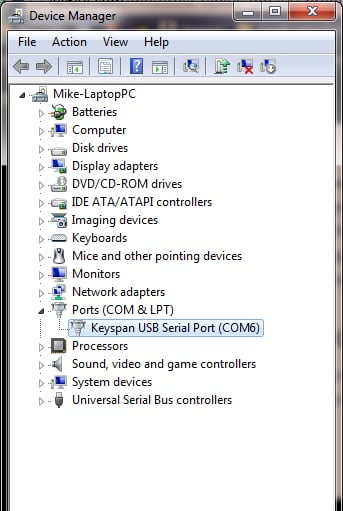
A: Because the serial cable connects to the computer through the computer's serial interface port, chances are that you can get it to work by changing the settings in the [serial] section of dosbox.conf. By default, the serial ports in dosbox.conf are either disabled or point to dummy ports. You'll need to know which serial port you've configured the Miracle to use (usually COM1) and revise the serial setting accordingly. Note that some modern computers don't have serial ports and have USB ports instead. In that case, you'll need a USB-serial adapter to use the Miracle serial cable. Make sure that, if you use a USB-serial adapter, the port setting for it corresponds to that for the Miracle. The Miracle can only use serial ports in the range COM1-COM2. Some such USB-serial adapters will default to a serial port like COM22. You will have to change that to get it to work with the Miracle. See the Wiki at http://www.dosbox.com/wiki/Dosbox.conf for more information on serial port configuration.
Q: Sound or video, when running the Miracle DOS software in DOSBox, are too slow/fast.
A: While most visitors to PEP who have tried DOSBox with the Miracle have had success, some have reported problems with sound or video being too slow or too fast. This arises because the writers of DOS programs simply didn't contemplate multi-threaded processors running with clock speeds in the GHz regime. DOSBox takes that into account by offering the ability to modify how fast the program runs under DOSBox. The relevant parameters are in the [cpu] and [mixer] sections of dosbox.conf. Comments within the dosbox.conf file explain the parameters and how to adjust them, but, if you need more information, there is another good Wiki on performance issues at http://www.dosbox.com/wiki/Performance.
Q: Do I need the font fix or NTFS4DOS add-ins under DOSBox?
A: Although these are often needed when running Miracle DOS directly under various versions of Windows, DOSBox handles screen fonts and file system issues itself, so most people will not need these additional programs when running Miracle DOS in DOSBox.
Q: Does this FAQ cover all the issues that might come up in using the Miracle DOS software with DOSBox?
A: No, there are a number of hardware-specific issues that we simply can't cover here. However, most people, if they look at the documentation online and in their dosbox.conf file can solve most problems that may occur. Numerous visitors to PEP have reported success using DOSBox in Windows; fewer numbers have reported testing it in other operating systems.
Other DOS programs
Q: Can I use DOSBox with other DOS programs and games?
A: Yes, it will work with a large number of other DOS programs, including games. You can find a listing of tested applications on the DOSBox site. I have tested a few other games and productivity applications, which also work well in DOSBox. There are some listed on the DOSBox site that don't work, though this may, in some cases, be a result of misconfiguration, rather than actual failure of the program to run.
Last updated: 05/25/19
| About Mount Issues Configuring Other Software Miracle FAQ Piano Education Home |